
SEO is cumulative. Some improvements can show movement quickly, especially when we’re fixing technical issues, cleaning up page structure, or strengthening internal linking on pages that already have visibility. More competitive keywords and broader growth usually take longer because the site has to earn trust over time. The goal isn’t a quick spike — it’s consistent momentum that compounds as your site becomes clearer, faster, and more authoritative.
SEM and Paid Search Management

Paid Search Built for Revenue and Lead Quality
SEM (Search Engine Marketing) is one of the fastest ways to generate demand because it puts your business in front of people who are already looking for what you offer. The problem is that most paid search accounts are built to “run,” not to perform. Budgets get wasted on broad queries, weak landing pages, unclear tracking, and campaigns that optimize for clicks instead of outcomes.
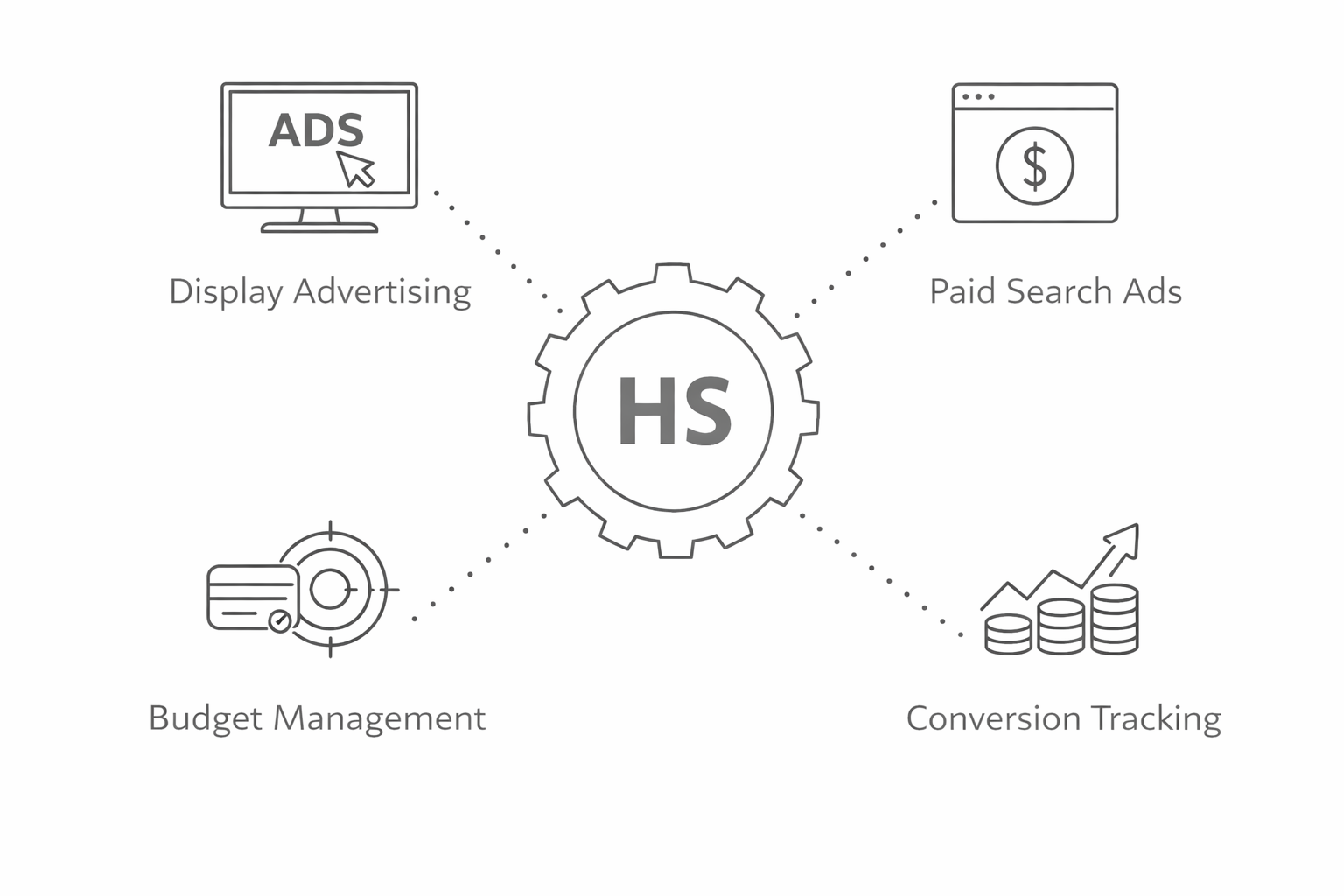
HS Creative manages paid search with a performance-first approach. We focus on targeting that matches real buyer intent, ad messaging that qualifies the right traffic, landing pages that convert, and tracking that tells the truth. The goal is simple: lower wasted spend, higher-quality leads or sales, and a system you can scale with confidence.
New business inquiries:
studio@hscreative.com

SEM That Stays Profitable in a Competitive Market
Paid search isn’t something you “set up” and then leave alone. Competition changes weekly, costs move constantly, and search behavior shifts as new competitors enter the auction and new search terms trend. Accounts that perform long-term are the ones that are actively managed with discipline: controlling query quality, tightening targeting, and keeping spend focused on searches that actually produce booked calls, qualified inquiries, or profitable orders.
Our approach is built around efficiency and intent. We don’t chase volume just to inflate traffic numbers. We protect your budget by filtering out low-value queries, eliminating waste, and building campaign structure that supports clean optimization. When the account is organized correctly, performance becomes easier to improve and easier to scale without breaking what’s already working.
We also keep the messaging tight so clicks are more qualified. Ad copy should do more than “get attention.” It should set expectations, reinforce credibility, and help the right people self-select. That reduces junk leads, improves conversion rate, and keeps cost per lead under control even as competition increases.
Most importantly, we treat SEM as more than an ad account. Paid search only works when the full experience works. If the landing page doesn’t match the search, if the offer is unclear, or if conversion tracking is incomplete, the campaign becomes expensive fast. We look at what happens after the click and fix the friction that blocks conversions, so paid search becomes a reliable growth channel instead of a monthly expense you keep questioning.
Search Intent Strategy That Improves Lead Quality
Not all keywords are equal, and not all clicks are valuable. Some searches are early research. Others are ready-to-buy signals. The difference shows up immediately in lead quality, close rate, and cost per acquisition. Most underperforming accounts fail because they target too broadly, mix different intent levels together, and then “optimize” based on data that’s already contaminated.
We build campaigns around intent and structure, not just more keywords. High-intent searches are separated and prioritized. Exploratory searches are handled intentionally, or excluded altogether if they don’t support the goal. Ad groups and messaging are built to mirror what the person is actually trying to accomplish, which pre-qualifies the click and reduces wasted spend.
This is where performance starts to feel consistent. When search intent is mapped correctly, you attract fewer junk leads, spend less time on unqualified calls, and put more budget behind the queries that produce real revenue. It also makes testing clearer, because you’re comparing like-for-like instead of mixing everything into one campaign and hoping the algorithm figures it out.
Google Ads and Microsoft Ads Management
Google Ads is usually the primary driver for paid search, but Microsoft Ads can be a strong secondary channel depending on your audience, industry, and buyer profile. We manage both when it makes sense, and we structure accounts so performance is measurable, scalable, and not dependent on “set it and pray” automation.
Our day-to-day management is focused on the mechanics that actually protect ROI: search query control, negative keyword strategy, budget allocation, bidding oversight, and ad testing that improves click quality and conversion rate. We keep the account clean and intentional so it doesn’t drift into wasted spend over time.
Most importantly, we manage toward outcomes, not activity. You’re not hiring us for “more impressions” or “more clicks.” You’re hiring us to drive profitable action — and to build an account that stays efficient as budgets grow, new campaigns launch, and your offering evolves.
If you want a short “what’s included” line without turning it into a big list, you can add this at the end:
Management typically includes campaign structure, keyword and query controls, negative keyword strategy, bidding and budget oversight, ongoing ad testing, and performance reporting tied to real outcomes.
HS Creative’s Approach to Web Design and Development
HS Creative treats SEO as a system, not a checklist. Rankings are the byproduct of clarity, structure, and consistency across your site. When the foundation is right, SEO becomes more predictable: service pages hold position longer, new pages perform faster, and improvements compound instead of resetting every time Google shifts.
We start by identifying what’s actually holding performance back. In many cases it isn’t “lack of content,” it’s overlap, weak page hierarchy, unclear service definitions, and internal linking that doesn’t reinforce priority pages. We tighten the structure so each page has a purpose, priority services are supported correctly, and search engines can understand what matters without confusion.
From there, we refine on-page content to match real search intent. That means writing and structuring pages in a way that answers the query directly, uses consistent terminology, and builds credibility quickly. The goal is not to chase keywords. It’s to build the strongest, clearest page in your market for the searches that drive business.
We also prioritize technical health because it’s the part most businesses ignore until it becomes a problem. Site speed, mobile behavior, indexing issues, template consistency, and clean internal linking all influence how well your content can compete. When technical friction is removed, your pages have a much better chance to rank and stay stable.
Finally, we focus on measurement that supports decisions. We track performance at the page level, tie SEO work to real outcomes, and use the data to prioritize what gets optimized next. SEO works best when it’s managed with discipline and aligned with the pages that actually drive leads or revenue.
New business inquiries:
studio@hscreative.com
What’s the difference between SEO and Local SEO?
SEO is your visibility across broader organic search results, often tied to service pages, informational queries, and competitive industry terms. Local SEO is focused on location-based searches, map visibility, and service-area intent (often where the best leads come from). Most businesses benefit from both, and the best performance happens when the website and local signals are aligned so Google understands exactly what you do and where you do it.
Do you guarantee rankings?
No — and any agency that guarantees rankings is overpromising. Search results shift based on competition, algorithm updates, and what Google decides is most helpful for a query. What we can control is execution: building stronger pages, improving technical foundations, aligning content with search intent, and creating a site structure that performs more reliably over time. That’s what produces durable results.
What does SEO Optimization include?
SEO Optimization isn’t just “adding keywords.” It’s improving the full system that influences organic performance: technical health, on-page structure, content clarity, and internal linking. We prioritize the pages that drive business value first — typically service pages and high-intent pages — then expand outward with supporting content that strengthens topical relevance. The focus stays on measurable improvements that support leads or revenue, not busywork.
Do you write content, or do you only optimize what we already have?
Both. In some cases, the fastest wins come from optimizing and restructuring what already exists: tightening service-page messaging, fixing overlap, improving headings, and cleaning up internal links. When content gaps are holding the site back, we’ll recommend what to add and why — usually starting with the pages most likely to drive qualified traffic. The goal is content that supports how people actually search and decide, not content created just to “publish more.”
How does SEO relate to AI Search and Generative Engine Optimization?
Traditional SEO is still critical, but AI-driven search is increasingly selecting and summarizing information instead of simply ranking pages. That means clarity, consistency, and credibility matter even more. SEO Optimization builds the foundation (structure, speed, intent alignment), and those same improvements increase the chances your site becomes a trusted source that can be referenced in AI-generated results. In other words, strong SEO doesn’t get replaced by GEO — it becomes the baseline that GEO builds on.
